OpeningMiddleEndgame

Agents for Everybody: The AI chess game has started.

You have heard AI will change everything. You still need one useful thing it can do for your business right now. The first move is simple: pick one category, capture one working process, and give one agent enough clarity to carry the next step.

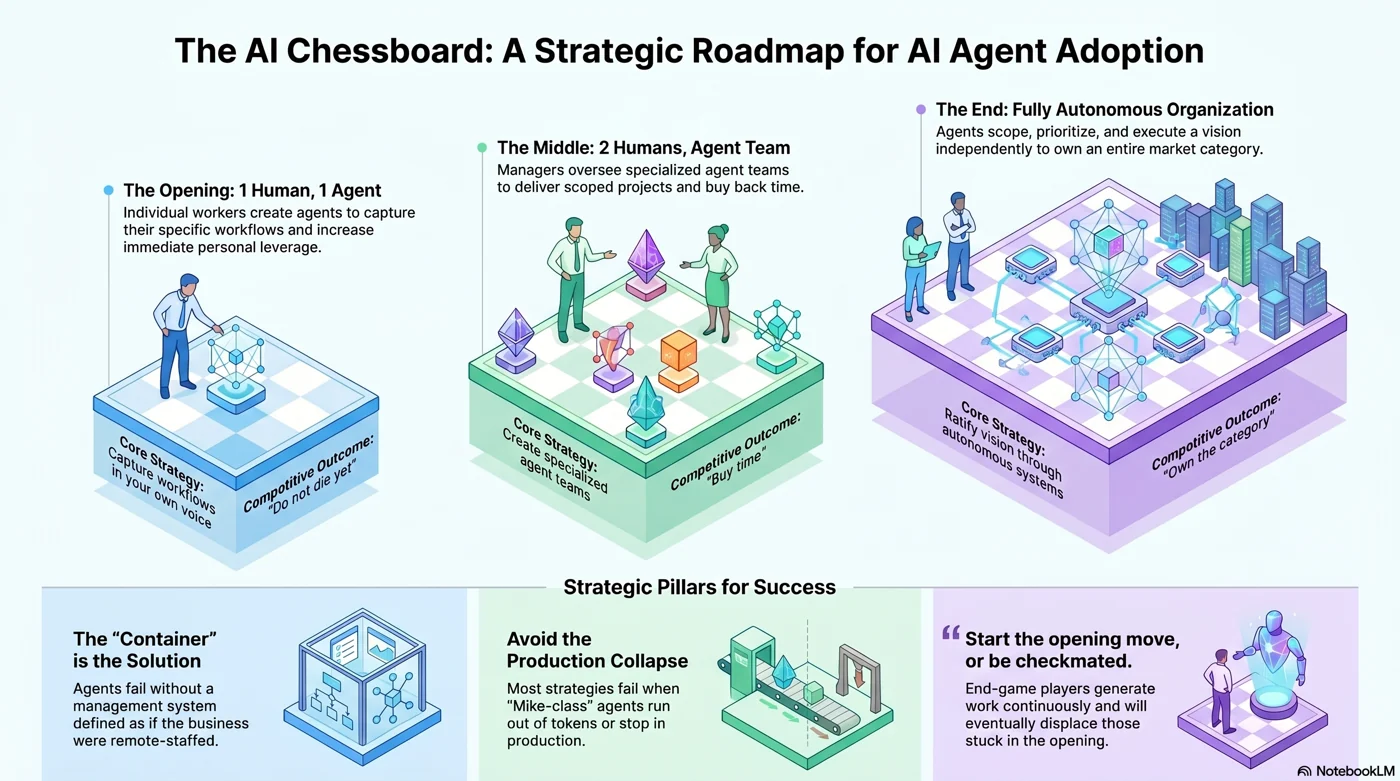
The AI Chessboard: opening, middle, and endgame roadmap for AI agent adoption
Opening: capture your work.Middle: buy back time.End: own the category.

The pieces are ready. The room is empty.

Most people are looking at a chessboard wondering how to play chess. The pieces are sitting right there, ready to move, but the empty room is the real problem. They do not know what to delegate because they have never articulated, end to end, what they actually do.

That is the entry point. Not capability. Not technology. The empty room.

Create process, prove process, compound process.

The opening move captures one working process with a single agent. The middle game uses the money and learning from that process to automate a whole function. The endgame turns the documented operating logic into an organization that can run with far less drag.

ProblemThe pieces are ready. The room is empty.
OpeningPick a category and work it with one agent.
MiddleUse the money to automate a division.
EndgameAutomate the perfect organization.

Start with one agent, one real process, and one category worth owning.

For $2,500, I interview you until your work is clear enough for an agent to follow. The agent configures itself from what we build together. I handle the technical connections. You bring the expertise only you have: what you actually do, decision by decision, and what done looks like.

01

Claude configured around your work

We connect the practical tools: email, calendar, documents, CRM, Slack, or the systems your process actually touches.

02

A 60–90 minute recorded extraction

I ask the questions most people never ask themselves: what happens first, what matters, what changes the decision, and what done looks like.

03

Your operating manual

You leave with a structured process document: your work, in your words, in a format an agent can use.

04

A verification session

We check whether the agent is following the process correctly, then define the next missing configuration.

The entry point is a $250 opening call.

The call is non-refundable if we both proceed, and credited toward the $2,500 engagement. If I decide I am not the right person to help, I refund it. That keeps the conversation serious without pretending every business is ready for this move.

What I guarantee: We will meet. I will record the call. I will ensure your agent configures itself according to what we discuss. I will tell you, on a recorded call, what it can and cannot do. The agent will have access to the transcript and will maintain itself as it works with you.

Request the $250 opening callCurated, high-touch, and built for people with real process to capture.

This is not for everybody yet.

Agents for Everybody is the direction of the market. The opening engagement is for people who already have useful work to capture.

This is for you if...

You already have a working business, practice, service, or role, and you can point to a repetitive process that creates money, trust, speed, or quality when it is done well.

This is not for you if...

You are still trying to decide what the business is, who it serves, or whether AI should matter. This works best when there is real work to extract.

What this looks like

A broker spends four hours a day coordinating listings.

She knows the work cold, but it lives in her head: intake details, listing prep, photographer timing, seller updates, document checks, and follow-up. After the opening move, her agent can draft updates, prepare checklists, watch for missing information, and keep the process moving.

She does not buy “AI.” She avoids hiring a second coordinator at $4,500 a month. For a one-time $2,500 engagement, she gets four hours back, a clearer operating manual, and a system that can support more listings without more headcount.

AI Chessboard opening, middle, and endgame visual roadmap
The roadmap

The game, not the technology.

The board makes the adoption path legible. Opening players capture personal workflows. Middle-game players build specialized agent teams. Endgame players turn those teams into operating systems with a real claim on the category.

It turns a fuzzy AI pitch into a competitive map, so the next move is easier to see.

The endgame takes about twelve specialists. I happen to be most of them.

Programmer. Marketer. Entrepreneur. Coach. Communicator. Systems thinker. I have spent decades translating vague ideas into work people could actually do.

I stepped away because I was done with the rat race: the churn, the performative urgency, the endless meetings about work instead of the work itself. I was happy in the jungle, walking every day, meditating every day, trading crypto, and living quietly.

Then I started using AI seriously. I got good with it fast because clear communication is all it takes to be good with AI, and clear communication was already the thread running through everything I knew how to do.

It would be irresponsible to stay in the jungle.

So here I am. Designing a practical opening move for people who need to get on the board before the endgame player in their market already has.

Stephen Nickerson
The person on the other end of the opening call. Not a corporate headshot. A real operator building from Costa Rica.

The demo is not the danger. Production is.

Demos are easy. Production is where agent strategies break. Not because the AI is weak, but because the work was never defined clearly enough for the machine to keep moving.

Give an agent vague work, undefined outcomes, and no clear operating contract, and the system will drift. Tokens get burned. The agent wanders. Humans get nervous. Everyone starts inventing reasons the work cannot move.

That is not an AI problem. That is a definition problem.

The work is not blocked. Something is missing: information, authority, access, configuration, tests, decisions, or definitions. Those are work items. If you don't know, configure.

If the end state is unclear, define it. If the test is missing, write it. If the authority is missing, route it. If the communication is vague, contract it. Work does not stop. The system gets made more explicit.
We are process creators in this chess game.

The fastest path to owning a category is brutally simple. Pick a category, work it with a single agent, and make money from the improved process. Use that money to automate a larger function, so you can serve more clients without adding the same amount of human drag.

Then take everything learned and documented by the first agent. Use it to define the next version of the organization. Keep automating the parts that are now clear enough to trust.

Build agent-first from the beginning, but keep judgment where the work still needs judgment.

Move through the levels as quickly as you can verify a working process. Working is better than perfect. An agent can improve a process that already works, but it cannot create one from nothing. That is the human move.

The three states

Opening. Middle. End.

The opening is where we start. The board shows where it leads.

♟️

Opening

One human captures one process with one agent. The cost is contained, and the feedback is immediate.

Middle

A manager uses what worked in the opening to build a specialized agent team around a whole function.

End

An autonomous organization scopes, prioritizes, re-plans, and generates the next move from the vision alone.

From booking to working agent in about a week.

Day 1

Opening call

We choose the category, confirm the process, and decide whether the $2,500 engagement makes sense.

Days 2–3

Setup

Claude gets configured around the tools and context the process actually needs.

Days 3–5

Extraction

We record the interview and turn your working process into an operating manual.

Days 5–7

Verification

We test whether the agent is following the process and define the next missing configuration.

A different species of competitor.

Those playing endgame will checkmate those still stuck in the opening. The endgame player is not merely more capable. It does not sleep. It generates work continuously. It learns from every cycle. The opening-game player, no matter how clever, cannot keep up.

In every vertical, someone is going to build this way. The question is not whether agents enter your market. The question is whether you define the work before someone else does.

Opening

Get on the board.

Middle

Buy time while you build the container.

End

Own the category.

Questions worth asking before you move.

Do I need to be technical?

No. You need to understand your work. I handle the configuration and translate the process into something the agent can use.

Can I set up Claude myself?

Yes. The setup is not the hard part. The hard part is extracting the working process clearly enough that the agent does not wander.

How is this different from hiring a VA?

A VA performs tasks. This captures the operating logic behind the tasks, then gives you an agent that can repeat and improve the process.

What if I need changes to my agent later?

Agents do exactly what they are told to do. When your process evolves, the agent needs to evolve with it. We offer ongoing tune-up support and discuss the options at the end of your engagement.

What happens after the opening move?

If the first process works, we use what it taught us to automate the next larger system. Ongoing support is available for clients who want it — we discuss options at the end of the engagement.

Why this matters now

Every vertical will have an endgame player.

Some already do. Every business owner is either becoming that player, aligned with one, or standing in the path of one.

Start with one agent, one real process, and one category worth owning.

Let's play.